Day 19 has us figuring out the right order to build resource collection devices to get the optimal number of end-of-chain resources. I have approached this as a Depth First Search. My solution works, but completed in a length of time measured in minutes, and would benefit from better pruning.
I am using some structs for the core concepts. The naming is a little tricky, with some overlap between Blueprints the unreal concept (solution space), and Blueprints the puzzle input concept (problem space).
constexpr int D19_None = -1;
constexpr int D19_Ore = 0;
constexpr int D19_Clay = 1;
constexpr int D19_Obs = 2;
constexpr int D19_Geode = 3;

// material costs for a thing
USTRUCT(BlueprintType)
struct FD19Costs
{
	GENERATED_BODY()
	int Mats[4];
};

// material costs for each thing
USTRUCT(BlueprintType)
struct FD19Blueprint
{
	GENERATED_BODY()

	UPROPERTY(BlueprintReadWrite)
	int Id;

	FD19Costs Bots[4];
	int Caps[4];
};

USTRUCT(BlueprintType)
struct FD19State
{
	GENERATED_BODY()
	int Mats[4]={0};
	int Bots[4]={0};
};
I will also use Test Automation, and structure the Actor around making that easy:
bool AoC2022D19_Test::RunTest(const FString& Parameters)
{
	FString BP1Line = TEXT("Blueprint 1:  Each ore robot costs 4 ore.  Each clay robot costs 2 ore.  Each obsidian robot costs 3 ore and 14 clay.  Each geode robot costs 2 ore and 7 obsidian.");
	FD19Blueprint BP1 = AD19Actor::ReadBlueprint(BP1Line);
	TestEqual(TEXT("BP1 Id = 1"), BP1.Id,1);

	FString BP2Line = TEXT("Blueprint 2:  Each ore robot costs 2 ore.  Each clay robot costs 3 ore.  Each obsidian robot costs 3 ore and 8 clay.  Each geode robot costs 3 ore and 12 obsidian.");
	FD19Blueprint BP2 = AD19Actor::ReadBlueprint(BP2Line);
	TestEqual(TEXT("BP2 Id = 2"), BP2.Id,2);

	TestEqual(
		TEXT("Using blueprint 1 ... the largest number of geodes you could open in 24 minutes is 9."),
		AD19Actor::Simulate(BP1, 24),
		9);

	TestEqual(
		TEXT("by using blueprint 2 ... the largest number of geodes you could open in 24 minutes is 12."),
		AD19Actor::Simulate(BP2, 24),
		12);

	return true;
}
ReadBlueprint is a static function on the actor. It reads the integers out of the string and puts them in an array. I use the array to fill out my robot “blueprint” spec. My first attempt at reducing the search space was, noting you can only build 1 robot at a time, to put a cap (maximum) on the harvesting robots, so I never build bots that would result in more resources gathered than can be used:
//static
FD19Blueprint AD19Actor::ReadBlueprint(FString& Line)
{
	TArray<int> Ints;
	Ints.Reserve(7);

	int Accu=0;
	for(int i=0;i<Line.Len();++i)
	{
		// scan to first number
		while (i<Line.Len() && !FChar::IsDigit(Line[i])) ++i;

		// parse the number
		if (i<Line.Len())
		{
			do
			{
				Accu = Accu*10 + Line[i]-'0';
				i++;
			}while (i<Line.Len() && FChar::IsDigit(Line[i]));
			Ints.Add(Accu);
			Accu = 0;
		}
	}

	ensure (Ints.Num()==7);

	FD19Blueprint Result;

	// zero the costs
	for (int i=0;i!=4;++i)
		for (int j=0;j!=4;++j)
			Result.Bots[i].Mats[j] = 0;

	Result.Id = Ints[0];
	// Ore bots are made of Ore
	Result.Bots[0].Mats[0] = Ints[1];
	// Clay bots are made of Ore
	Result.Bots[1].Mats[0] = Ints[2];
	// Obsidian  bots are made of Ore and Clay
	Result.Bots[2].Mats[0] = Ints[3];
	Result.Bots[2].Mats[1] = Ints[4];
	// Geode bots are made of Ore and Obsidian
	Result.Bots[3].Mats[0] = Ints[5];
	Result.Bots[3].Mats[2] = Ints[6];

	// given we can only buy one bot per turn,
	// work out the maximum usable number of each bot type
	// if the most ore a bot costs is 1 Ore the, having more than 1 Ore bot is useless
	for (int i=0;i!=4;++i)
	{
		Result.Caps[i]=0;
		for (int b=0;b!=4;++b)
			if (Result.Caps[i] < Result.Bots[b].Mats[i])
				Result.Caps[i] = Result.Bots[b].Mats[i];
	}

	// geode bots are uncapped
	Result.Caps[D19_Geode] = INT_MAX;

	return Result;
}
With the branch in the search being what bot to build, the order of operations: select what to build, collect resources, build that bot, made structuring the recursion feel awkward. This is what ended up with:
int BuyAndContinue(const FD19Blueprint& Blueprint, FD19State State, int Bot, int Minutes)
{
	int Result = State.Mats[D19_Geode];

	// pay
	if (Bot>-1)
	{
		for (int i=0;i!=4;++i)
			State.Mats[i] -= Blueprint.Bots[Bot].Mats[i];
	}

	while (Minutes)
	{
		// collect resources
		for (int i=0;i!=4;++i)
			State.Mats[i] += State.Bots[i];

		// acquire the bot
		if (Bot>-1) State.Bots[Bot]++;
		Bot=-1;

		// work out what we can afford, high end first
		for (int b=3;b>=0;--b)
		{
			if (State.Bots[b]<Blueprint.Caps[b])
			{
				bool CanAfford = true;
				for (int i=0;i!=4 && CanAfford;++i)
					CanAfford = State.Mats[i] >= Blueprint.Bots[b].Mats[i];
				if (CanAfford)
				{
					int R = BuyAndContinue(Blueprint, State, b, Minutes-1);
					if (R>Result) Result=R;

					// if i can buy a higher end robot, do not consider any alternatives
					// break; [fast but fails tests]
					if (b==D19_Obs || b==D19_Geode) break;
				}
			}
		}

		// loop instead of recurse for the no-purchase path
		int R = State.Mats[D19_Geode];
		if (R>Result) Result=R;
		Minutes = Minutes-1;
	}

	return Result;
}

int AD19Actor::Simulate(FD19Blueprint Blueprint, int Minutes)
{
	FD19State State;
	State.Bots[D19_Ore]=1;

	return BuyAndContinue(Blueprint, State, -1, Minutes);
}
Note the “if (b==D19_Obs || b==D19_Geode) break;” this prune was the game-changer that made the solution viable. As you can see, I tried break unconditionally first, but the Blueprint 2 example test fails with that change.
With that C++ in place, the Unreal Blueprint to solve Part 1 looks like this (wired from Event Tick):
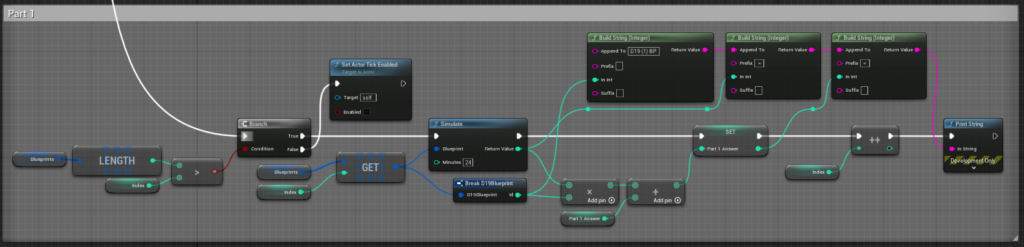
Each tick takes about a second. Fast enough to watch but slow enough to be harmful to interactivity. I unwired Part 1 to run the BP for Part 2:
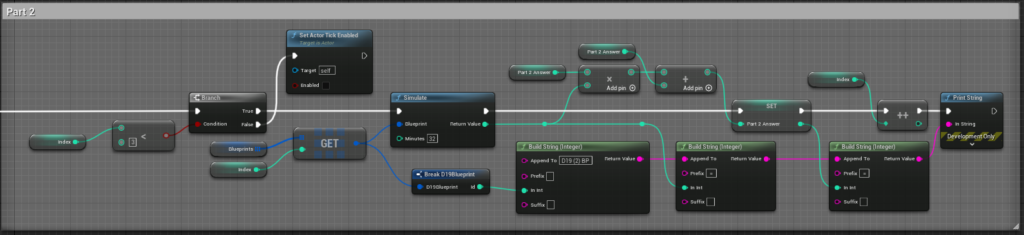
Part 2 takes minute(s) per line but with just 3 lines to process and the correct answer for my second star, I’m not motivated to optimize it further.
The pattern that is forming as these get harder is: Problem state in USTRUCT(s), C++ static functions on an Actor that can be unit tested in isolation, and an Actor to hook puzzle input up and tick the problem solver in BP.