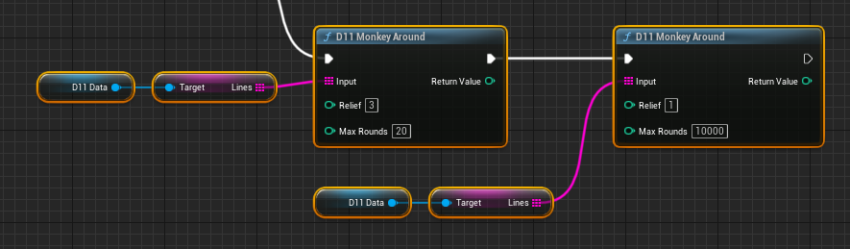
Day 11 is all about the big numbers, and doing it in Unreal didn’t help me at all. Some horrible input handing, and some nasty gotchas. It’s all in C++.
It starts with the Monkey struct. A plain old C++ struct, and really just so I can mangle the text input into memory:
static const FString starting_str = TEXT("  Starting items: ");
static const FString operation_str = TEXT("  Operation: new = old ");
static const FString test_str = TEXT("  Test: divisible by ");
static const FString test_true = TEXT("    If true: throw to monkey ");
static const FString test_false= TEXT("    If false: throw to monkey ");

struct Monkey
{
	TArray< int64 > Items;
	FString Op;
	int64 Test;
	int TrueDest;
	int FalseDest;
	uint64 Inspections=0;

	Monkey(const TArray<FString>& Input, int& Line)
	{
		TArray<FString> Strings;
		ensure(Input[Line].StartsWith(starting_str));
		Input[Line].RightChop(starting_str.Len()).ParseIntoArray(Strings, TEXT(","));
		for (auto S : Strings)
			Items.Add( FCString::Atoi(*S) );
		Line++;

		ensure(Input[Line].StartsWith(operation_str));
		Op = Input[Line].RightChop(operation_str.Len());
		Line++;

		ensure(Input[Line].StartsWith(test_str));
		Test = FCString::Atoi(*Input[Line].RightChop(test_str.Len() ));
		Line++;

		ensure(Input[Line].StartsWith(test_true));
		TrueDest = FCString::Atoi(*Input[Line].RightChop(test_true.Len() ));
		Line++;

		ensure(Input[Line].StartsWith(test_false));
		FalseDest = FCString::Atoi(*Input[Line].RightChop(test_false.Len() ));
		Line++;
	}
};
Then that is used by a single function that can handle either parts 1 and part 2 via the Relief and MaxRounds arguments:
//static
int UAoC22BPFunctionLibrary::D11_MonkeyAround(const TArray<FString>& Input, int Relief, int MaxRounds)
{
	int Line = 0;
	TArray< Monkey* > Monkeys;

	while (Line<Input.Num())
	{
		// skip monkey id, just goes up
		Line++;

		Monkeys.Emplace(new Monkey(Input, Line));

		// skip blank line
		Line++;
	}

	// find the combined multiplier of all the monkeys tests
	// see: https://en.wikipedia.org/wiki/Chinese_remainder_theorem
	int64 combined = 1;
	for (auto M : Monkeys)
	{
		combined *= M->Test;
	}

	for (int Rounds=0; Rounds!=MaxRounds; ++Rounds)
	{
		// ROUND
		for (auto M : Monkeys)
		{
			// TURN
			const int i = 0;
			while (M->Items.Num())
			{
				int64 OpVal = (M->Op.EndsWith(TEXT("old")))
					? M->Items[i]
					: FCString::Atoi(*M->Op.RightChop(2));

				switch (**M->Op)
				{
				case '*': M->Items[i] *= OpVal; break;
				case '+': M->Items[i] += OpVal; break;
				default: UE_LOG(LogTemp, Warning, TEXT("Expected Op: %s"), *M->Op); break;
				}

				M->Items[i] /= Relief;
				M->Items[i] %= combined;// keep it from overflowing

				if ((M->Items[i] % M->Test)==0)
				{
					Monkeys[M->TrueDest]->Items.Add( M->Items[i] );
					M->Items.RemoveAt(i);
				}
				else
				{
					Monkeys[M->FalseDest]->Items.Add( M->Items[i] );
					M->Items.RemoveAt(i);
				}

				M->Inspections++;
			}
		}
	}

	int C=0;
	for (auto M : Monkeys)
	{
		UE_LOG(LogTemp, Warning, TEXT("Monkey %i inspected items %i times."), C, M->Inspections);
		C++;
	}
	Monkeys.Sort([](auto a, auto b){return a.Inspections > b.Inspections;});
	UE_LOG(LogTemp, Warning, TEXT("Monkey business: %i * %i = %llu"),
		Monkeys[0]->Inspections, Monkeys[1]->Inspections, Monkeys[0]->Inspections*Monkeys[1]->Inspections);

	return 0;
}
This jumped out as “probably needs 64 bit ints” right away, but 2 further stumbling blocks held me up a long time:
- It overflows even 64 bits in the Items value repeatedly. You need to use Chinese remainder theorem to prevent that from affecting the results.
- The final combined monkey business result is also a large number. Forgetting to use %llu in my logging had me scratching my head for ages.